What You Need to Know About Flat Roof Boston Systems
Flat roof Boston properties are everywhere — from triple-deckers in Dorchester to commercial buildings in the Seaport District. Here’s a quick breakdown of what you need to know:
- Most common materials: EPDM rubber, TPO, PVC, and Modified Bitumen
- Typical lifespan: 20 to 50+ years depending on material and maintenance
- Biggest local challenges: Snow loads, ice dams, ponding water, and freeze-thaw cycles
- Average installed cost: Roughly $5 to $18 per square foot (based on publicly available data; not Twin Metals pricing)
- Key maintenance rule: Inspect twice a year — spring and fall — plus after major storms
Boston’s dense urban landscape and older building stock make flat roofs a practical necessity, not just a style choice. But the city’s brutal winters and humid summers put flat roofing systems under serious stress. A roof that isn’t built or maintained correctly won’t last — and in New England, that’s an expensive mistake.
This guide walks you through everything: materials, climate challenges, maintenance, costs, and how to find the right contractor for your property.
I’m Tom Gordon, owner of Twin Metals, Inc. and Twin Roofing — a Massachusetts-based roofing company with nearly two decades of hands-on experience installing and maintaining flat roof Boston systems for residential and commercial clients. I’ll share what I’ve learned so you can make the smartest decision for your property.
Know your Flat roof Boston terms:
Understanding the Popularity of a Flat Roof in Boston
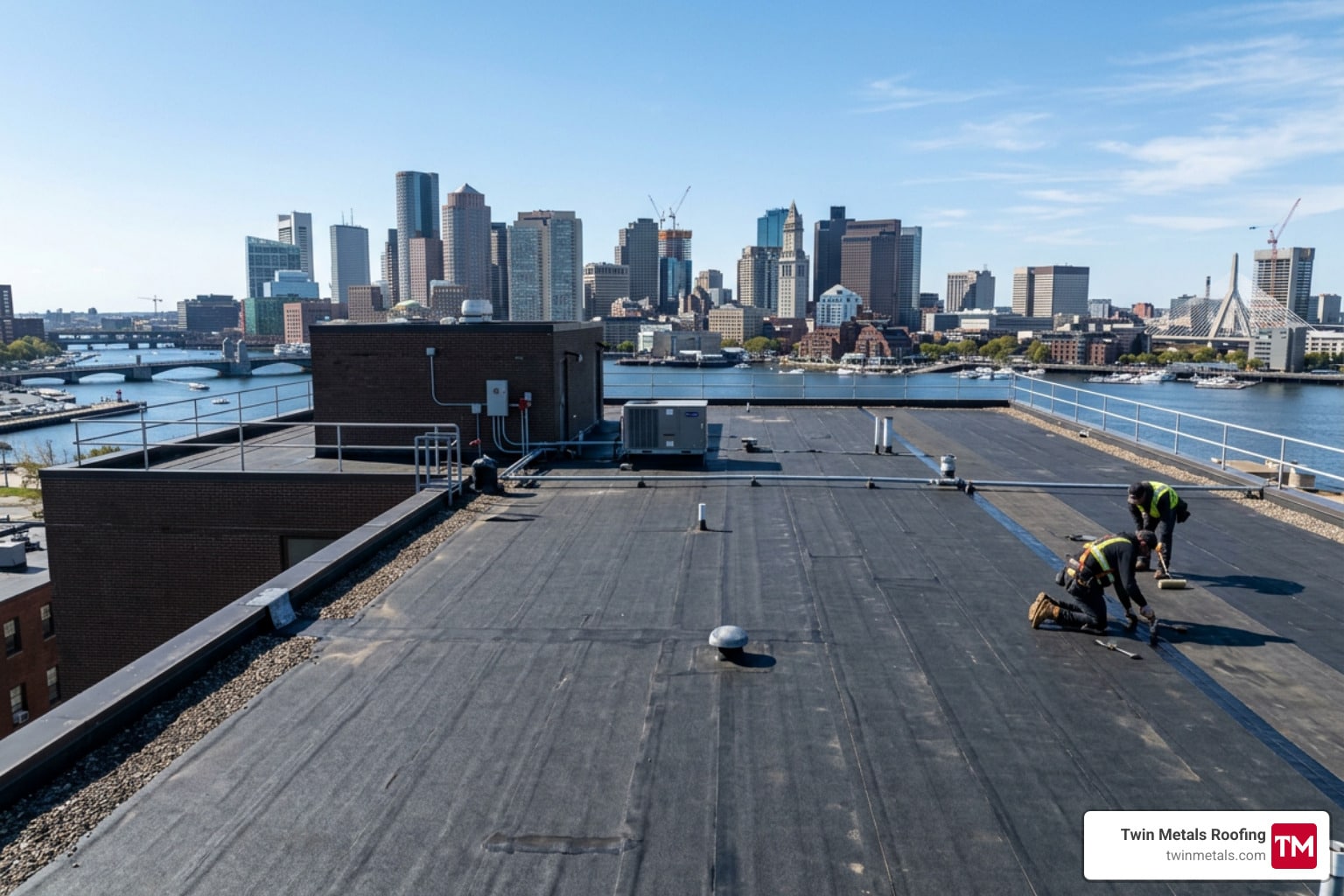
Walk through any neighborhood from South Boston to Cambridge, and you’ll see why flat roofs are the unsung heroes of our skyline. In a city where space is more precious than a front-row seat at Fenway, flat roofs offer something a sloped roof never could: usable square footage.
Space Maximization and Rooftop Decks
In areas like South Boston and the North End, property owners utilize flat roofs to create stunning rooftop decks. These “outdoor living rooms” provide extra square footage for entertaining, gardening, or simply enjoying a view of the Harbor. However, this isn’t as simple as throwing some lawn chairs on the roof. It requires a high level of Residential Roofing expertise to ensure the structural integrity can handle the “live load” of people and furniture without compromising the waterproof membrane.
HVAC and Equipment Placement
For Commercial Roofing in Boston, flat roofs are a practical necessity. They provide a stable, out-of-sight platform for massive HVAC units, solar panels, and ventilation systems. In dense urban environments where there is zero “yard space,” the roof is the only place these essential systems can go.
Urban Density and Historical Architecture
Many of Boston’s historic multi-family homes, including the famous brownstones, were designed with flat or low-slope roofs to fit tightly within city blocks. This design allowed for maximum interior ceiling height across the entire floor plan. Today, we see this tradition continue in modern apartment complexes in areas like Waltham and Quincy, where flat roofs help keep building profiles sleek and contemporary.

Common Materials for a Flat Roof Boston System
Choosing the right material is the most important decision you’ll make for your flat roof Boston project. Not all membranes are created equal, especially when they have to survive a New England Nor’easter.
The Big Four: EPDM, TPO, PVC, and Modified Bitumen
We often get asked which material is “the best.” The truth is, it depends on your building’s use, your budget, and whether you plan on walking on it.
| Material | Primary Benefit | Typical Lifespan | Energy Efficiency |
|---|---|---|---|
| EPDM (Rubber) | Extremely durable & cost-effective | 25–50 years | Moderate (absorbs heat) |
| TPO (Thermoplastic) | Highly reflective & eco-friendly | 20–30 years | High (reflects UV) |
| PVC (Vinyl) | Chemical & fire resistant | 25–50+ years | Very High |
| Modified Bitumen | Tough, multi-layered “old school” | 15–25 years | Low to Moderate |
Performance of EPDM in New England
EPDM (Ethylene Propylene Diene Terpolymer) is essentially a high-tech Residential Rubber Roofing membrane. It has been the industry standard for nearly half a century. As noted by the EPDM Roofing Association, these systems provide outstanding performance in reducing environmental impact and offer great economic value.
In Boston, EPDM is a favorite because it handles our freeze-thaw cycles beautifully. Because it is a synthetic rubber, it can stretch and contract as the temperature swings from 90°F in July to -10°F in January without cracking. The black color is also a “pro” in our climate; it absorbs heat during the winter, helping to melt snow and ice faster, which reduces the load on your structure.
Energy Efficiency of TPO and PVC
If you are looking for Commercial Rubber Roofing that helps lower your cooling bills, TPO (Thermoplastic Polyolefin) or PVC are your best bets. These are “Cool Roofs”—usually bright white—that reflect UV rays rather than absorbing them.
- TPO: Known for its heat-welded seams, which are physically stronger than the membrane itself. It’s a great mid-range option for energy-conscious owners.
- PVC: The “gold standard” for flat roofs. It is incredibly resistant to chemicals (great for restaurants with grease vents) and fire. PVC seams are also heat-welded, creating a monolithic, watertight sheet across your entire building.
Navigating Boston’s Harsh Climate: Snow, Ice, and Heat
A flat roof Boston system doesn’t just sit there; it fights a battle against the elements every single day.
The Danger of Ponding Water
“Ponding” occurs when water sits on a flat roof for more than 48 hours without evaporating or draining. In the summer, this water can act like a magnifying glass, intensifying UV damage. In the winter, it turns into a block of ice that expands and puts immense pressure on your seams. We always ensure a slight pitch is incorporated into our installations to guide water toward drains and gutters.
Ice Dams and Heavy Snow Loads
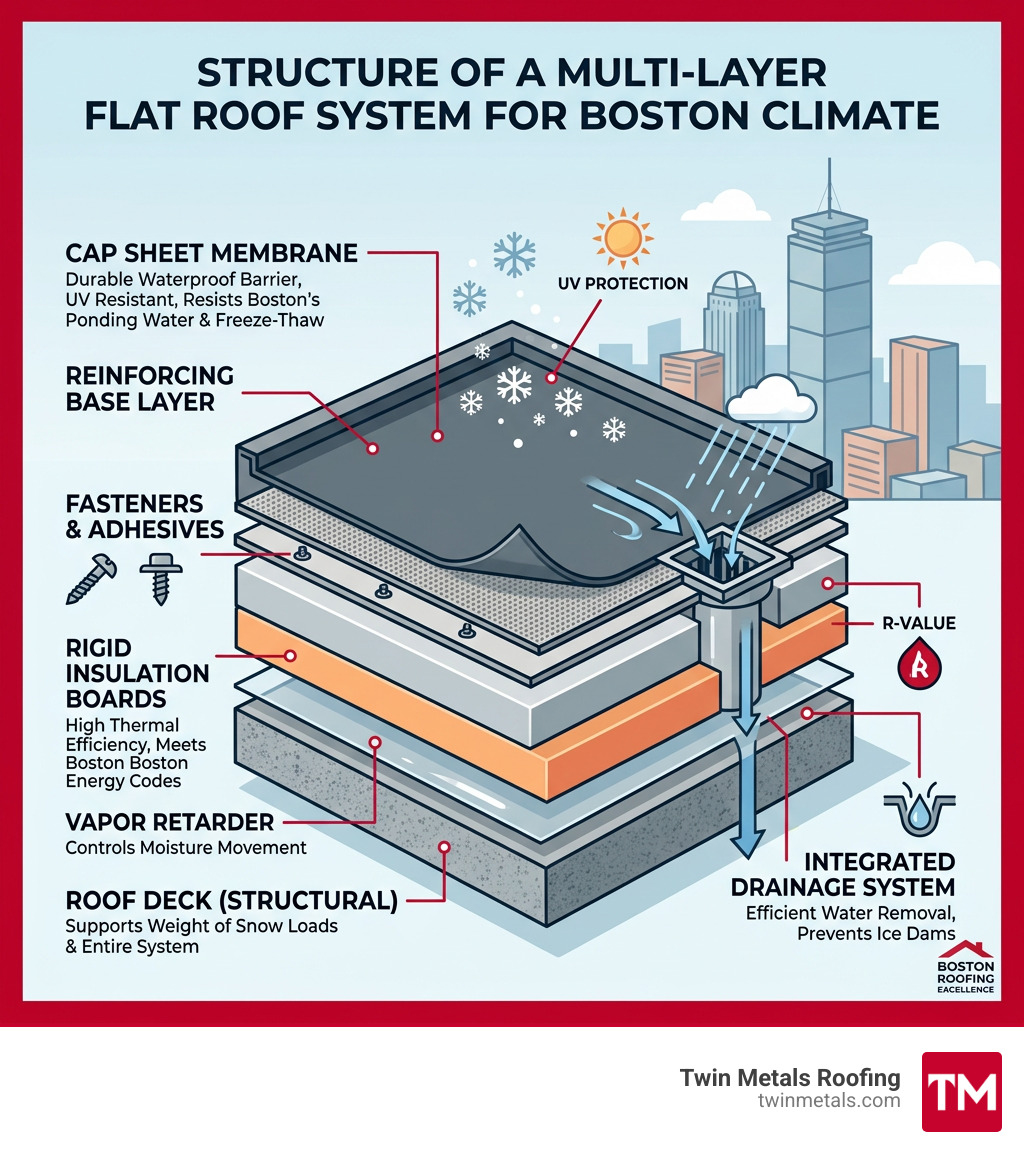
While ice dams are usually associated with sloped roofs, they can happen on flat roofs too, especially around the perimeter or near scuppers. When snow melts due to heat escaping from the building and then refreezes at the cold edges, it creates a dam. This forces water backward under the membrane seams. Proper insulation R-values and condensation control are critical components of any roof we install in our Service Area, from Billerica to Newton.
Thermal Expansion
The temperature in Massachusetts can change by 40 degrees in a single day. This causes materials to expand and contract. If your roof was installed by someone who didn’t account for this “thermal shock,” you’ll see the membrane start to pull away from the walls or flashings.
Maintenance and Repair for Your Flat Roof Boston Property
We tell all our clients: a flat roof is not a “set it and forget it” system. Because it doesn’t have the benefit of gravity to shed debris, it needs a little more love.
The Bi-Annual Inspection
You should have your roof checked every spring and fall. Why?
- Spring: To check for damage caused by winter ice and snow removal tools.
- Fall: To clear out leaves and debris that will clog your drains and lead to ponding.
If you suspect an issue, it’s better to Request Estimate early. A small seam repair is a few hundred dollars; a full interior ceiling replacement after a blowout is thousands.
Identifying Signs of Flat Roof Failure
Keep an eye out for these “red flags”:
- Alligatoring: When the surface of a bitumen roof cracks and looks like reptile skin. This means the UV rays have dried out the oils in the material.
- Punctures: Often caused by dropped tools, HVAC technicians, or even heavy hail.
- Blistering: Bubbles forming under the membrane, usually caused by trapped moisture or poor adhesion during installation.
- Sagging: If you see large areas where water is pooling that didn’t used to be there, your decking might be weakening.
Professional Restoration vs. Replacement
Not every leaky roof needs to be torn off. If the underlying insulation is dry and the structure is sound, we may recommend a fluid-applied coating. These restoration systems can stop leaks and extend the life of your roof by 10 to 20 years. Plus, they reduce landfill waste and can lower energy consumption by up to 20% on average.
Investment and Longevity: What to Expect
When you invest in a flat roof Boston system, you’re paying for peace of mind. While the upfront cost might be higher than a simple shingle roof, the longevity and functionality often provide a better return on investment.
Lifespan Statistics
- EPDM: 25–50 years (with an acrylic refresh every 10–15 years)
- TPO/PVC: 25–30+ years
- Modified Bitumen: 15–25 years
Warranties and Guarantees
Reputable contractors in Massachusetts should offer both a manufacturer’s warranty (covering the material) and a workmanship guarantee (covering the labor). At Twin Metals, we emphasize using quality materials because we know they stand up to the local weather. Whether you’re in Acton, Andover, or Wellesley, you want a warranty that actually means something. You can learn more about our commitment to quality on our About Us page.
Average Costs for Flat Roofing in Boston
Pricing in the Boston area varies wildly based on the height of the building, the number of penetrations (like vents and chimneys), and the current state of the existing roof.
| Service Type | Average Price Range (Per Sq. Ft.) |
|---|---|
| New Installation / Replacement | $8.00 — $18.00 |
| Basic Repair / Patching | $5.00 — $12.00 |
| Fluid-Applied Coating | $6.00 — $14.00 |
Note: These prices are based on publicly available internet data for the New England region and do not reflect the actual pricing of Twin Metals Roofing. For a specific quote, please contact us directly.
Frequently Asked Questions about Boston Flat Roofing
How long does a flat roof last in Massachusetts?
In our experience serving areas from Billerica to West Roxbury, a well-installed EPDM or PVC roof can easily last 30 to 40 years. However, if maintenance is neglected and drains remain clogged, that lifespan can be cut in half. The freeze-thaw cycle is the biggest “roof killer” in Massachusetts, so choosing a flexible material like EPDM is key.
Are there energy incentives for flat roofs in Boston?
Yes! Many property owners in Massachusetts can take advantage of programs like Mass Save for insulation upgrades. Additionally, installing a “Cool Roof” (TPO or PVC) can sometimes qualify for federal tax credits or local energy rebates because they significantly reduce the “Urban Heat Island” effect in cities like Boston and Cambridge.
Can I put a deck on my flat roof?
Usually, yes — but you must consult a professional first. You need to ensure the structure can support the weight and that you use a “pedestrian membrane” or a sleeper system that doesn’t puncture the waterproofing. We often see homeowners in Brookline and Somerville add beautiful decks, but it requires careful planning to avoid voiding your roof warranty. Check out our Residential Roofing section for more on specialized home projects.
Conclusion
A flat roof is a major investment for any Boston property owner. Whether you are managing a commercial warehouse in Peabody or a modern home in Lexington, the goal is the same: a watertight, energy-efficient system that lasts for decades. By choosing the right materials — like EPDM for its durability or TPO for its reflectivity — and staying on top of bi-annual maintenance, you can ensure your roof stays healthy through the worst New England winters.
At Twin Metals Roofing, we specialize in both residential and commercial solutions. While we are experts in flat roof Boston systems, we also emphasize superior performance in asphalt shingles and metal roofing. We believe in quality materials and exceptional customer service, ensuring that every project we touch is built to last.
If you’re worried about a leak or thinking about a full replacement, don’t wait for the next big storm. Request Estimate today and let us help you protect your investment.
Twin Roofing, a division of Twin Metals, Inc., installs asphalt roofs in MA and NH. Our company services Berkshire County in Eastern Massachusetts and Southern New Hampshire.
Follow us on Facebook — https://www.facebook.com/twinmetalsroofing Follow us on Instagram – https://www.instagram.com/twinmetals/