Why Siding Repair in Boston Deserves Your Attention Before Winter Hits
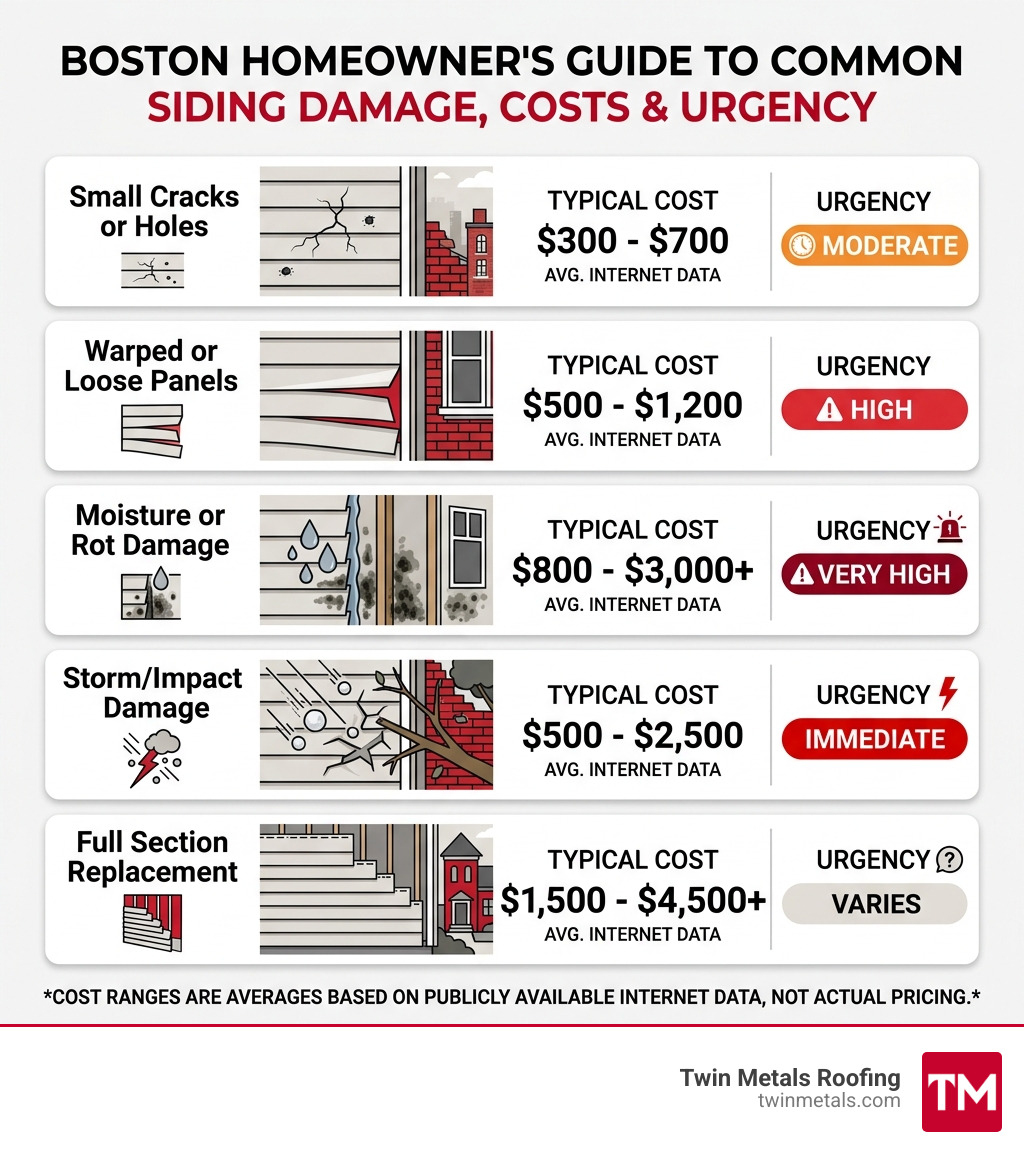
Siding repair Boston homeowners need most often falls into these common categories:
| Repair Type | Typical Cost (Avg. Internet Data) | Urgency |
|---|---|---|
| Small cracks or holes | $300 – $1,500 | Moderate |
| Warped or loose panels | $500 – $2,500 | High |
| Moisture or rot damage | $800 – $4,000+ | Very High |
| Storm/impact damage | $500 – $3,000 | Immediate |
| Full section replacement | $1,500 – $7,500+ | Varies |
Note: These are average cost ranges based on publicly available internet data, not Twin Roofing’s actual pricing.
Boston homes take a beating. Harsh winters, freeze-thaw cycles, heavy rain, and humid summers all work against your exterior siding year after year. When siding cracks, warps, or pulls away from the wall, it stops being just a cosmetic problem. Water gets behind it. Rot sets in. Energy bills climb. What starts as a small fix can quietly turn into a costly structural repair.
The good news? Most siding damage caught early can be repaired — not replaced — saving you thousands of dollars.
I’m Tom Gordon, owner of Twin Metals, Inc. and Twin Roofing, with nearly two decades of hands-on experience helping Massachusetts and New Hampshire homeowners protect their homes from the outside in. My work on exterior systems across New England gives me a practical, ground-level understanding of what siding repair in Boston actually demands — and what it costs when ignored.
Siding repair Boston terms you need:
Identifying Common Signs You Need Siding Repair in Boston
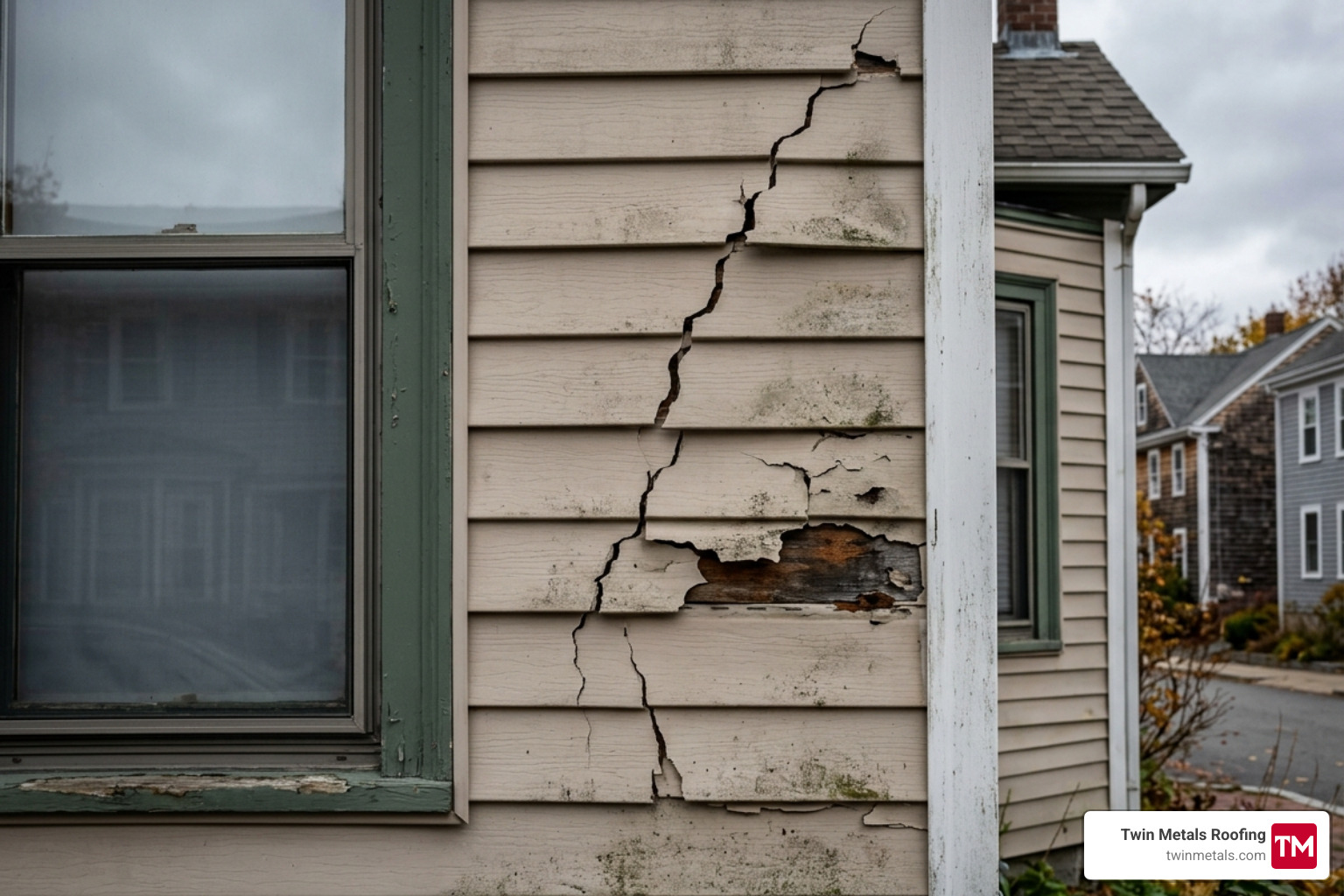
Living in neighborhoods like West Roxbury, Newton, or Brookline means your home is the first line of defense against the Atlantic’s mood swings. Often, we don’t look closely at our siding until a neighbor points something out or we see a stain on the interior drywall. By then, the “repair” has likely become an “operation.”
Here are the red flags every Bostonian should watch for:
- Visible Cracks and Chips: These are common after a hail storm or a particularly brutal freeze-thaw cycle. Even a small crack in vinyl or fiber cement allows moisture to seep behind the panel.
- Warping and Buckling: If your siding looks like it’s “waving” at you, it’s likely warped. This often happens to vinyl siding due to improper installation (nailing it too tight) or extreme heat exposure.
- Bubbling and Peeling Paint: On wood siding, peeling paint isn’t just an aesthetic issue; it’s a sign that the wood is no longer protected from the elements. On the interior, bubbling wallpaper or peeling paint can actually indicate that siding has failed and water is entering the wall cavity.
- Rot and Soft Spots: This is the nemesis of wood siding. If you can poke a screwdriver into a board and it feels like a ripe peach, you have rot. In Boston’s humid summers, mold and mildew can also hitch a ride on these damp spots.
- Loose or Missing Sections: High winds during Nor’easters can rattle panels loose. If you hear a “clapping” sound during a storm, your siding is likely loose.
- Pest Intrusion: Termites, carpenter ants, and even rodents love gaps in damaged siding. If you see sawdust (frass) or small holes, your siding repair just became a pest control issue too.
Material Matters: Repairing Different Siding Types
Boston is a beautiful mix of historic triple-deckers and modern builds. Consequently, we see everything from 100-year-old cedar to the latest composite materials. Understanding what’s on your walls is the first step toward a successful fix. We often discuss these materials when integrating Gutters, Siding & Soffits into a comprehensive home protection plan.
Vinyl Siding Repair Boston
Vinyl is the most popular choice in areas like Malden and Quincy because it’s affordable and low-maintenance. However, it isn’t invincible.
- The Fix: Small holes can sometimes be patched with specialized vinyl siding caulk. For larger cracks or impact damage (looking at you, stray baseballs), we typically replace the entire panel.
- The Challenge: Color matching is the biggest hurdle. Vinyl fades over time due to UV exposure. A brand-new “Pacific Blue” panel might look neon next to a panel that’s sat in the sun for ten years. Professionals often “harvest” a panel from a less visible part of the house (like the back of the garage) to use for the repair, replacing the hidden spot with the new, slightly off-color panel.
Wood and Fiber Cement Restoration
Wood siding (cedar shingles or clapboard) offers unmatched beauty but requires the most “love.” Fiber cement, like James Hardie, mimics wood but is much tougher.
- Rot Treatment: For wood, we must remove the rotted section entirely. If the rot has reached the sheathing (the wood underneath the siding), that has to be replaced too. We then treat the surrounding wood with preservatives.
- Fiber Cement Patching: Fiber cement is incredibly durable but can crack if the house settles. These cracks are repaired using high-quality, paintable caulk designed specifically for masonry products.
- Specialized Flashing: Both materials rely heavily on flashing—those metal bits that redirect water. If your flashing is rusted or missing around chimneys or windows, the best siding in the world won’t keep you dry.
The Importance of Timely Siding Repair in New England
In Boston, “later” is a dangerous word when it comes to home maintenance. Our climate is uniquely aggressive. We have the “Big Three” to worry about:
- The Freeze-Thaw Cycle: Water enters a small crack in your siding during a rainy November day. That night, it freezes and expands. This turns a hairline fracture into a gaping hole by January.
- Humidity and Mold: Our summers are humid. Damaged siding traps that moisture against your home’s wooden frame. This creates a greenhouse effect for mold and wood rot, which can compromise your indoor air quality.
- Energy Efficiency: Siding isn’t just a raincoat; it’s a windbreaker. Gaps in your siding allow “thermal bridging,” where heat escapes your home in the winter and enters in the summer. According to the U.S. Department of Energy, maintaining your home’s exterior envelope is key to reducing energy loss. Repairing these gaps reduces the workload on your HVAC system and keeps your utility bills from skyrocketing.
Understanding Costs and Local Regulations for Boston Siding Projects
One of the most common questions we get at Twin Roofing is, “What’s this going to cost me?” While every home is different, we can look at the general market trends for the Greater Boston area.
Professional Siding Repair Boston Cost Factors
Based on internet data for the Boston market, most homeowners spend between $300 and $1,500 for a standard repair. However, if the damage is extensive or involves high-end materials, that range can shift significantly.
| Project Scope | Average Cost Range (Internet Data) |
|---|---|
| Minor Patching/Caulking | $300 – $1,500 |
| Partial Wall Replacement | $1,500 – $7,500 |
| Emergency Storm Repair | $500 – $3,500 |
| Full Siding Replacement | $12,000 – $120,000+ |
Note: These ranges are based on public internet data and are not representative of Twin Roofing’s specific pricing. The high end of replacement can be 3x or more than the average depending on material (e.g., stone veneer or premium cedar).
Factors that influence your price include:
- Material: Vinyl is generally the cheapest to repair, while fiber cement and cedar shingles require more specialized labor.
- Height: A three-story Victorian in Somerville requires more scaffolding and safety equipment than a ranch in Billerica.
- Underlying Damage: If we pull back a panel and find rotted plywood or pest damage, the scope of the project grows.
Local Permits and Building Codes
Do you need a permit for siding repair in Boston? Generally, for minor repairs (replacing a few boards), you might not. However, for “siding replacement” or significant structural repairs, the City of Boston and surrounding towns like South Boston require a residential building permit.
If you live in a historic district—like parts of Back Bay or the South End—you also have to deal with the Landmarks Commission. They have very strict rules about what materials you can use. You can’t just slap vinyl on a historic brick-and-wood row house without a few stern letters (and potential fines).
Frequently Asked Questions about Siding Maintenance
How long does a professional siding repair project usually take?
Most standard siding repair Boston projects are surprisingly quick. A professional crew can usually handle minor to moderate repairs in 4 to 8 hours. If we are replacing an entire side of a house or dealing with significant rot, it might take 2 to 3 days. The biggest delay in New England is always the weather—we can’t effectively seal or paint siding in a downpour or a blizzard!
Should I repair or replace my siding?
This is the $10,000 question. We generally recommend repair if:
- The damage is localized to one area (like a single wall or the lower two feet of the house).
- The rest of the siding is in good structural shape.
- You can achieve a reasonable color match.
We recommend replacement if:
- More than 25-30% of the house is damaged.
- You are constantly finding new soft spots or cracks.
- Your energy bills are high and the siding is old (lacking modern insulation/house wrap).
- You’re planning to sell and the current siding is severely dated or faded.
How does siding repair improve home energy efficiency?
Think of your home like a cooler. If the lid is cracked, the ice melts. Siding acts as the “envelope” of your home. When we perform a siding repair in Boston, we aren’t just replacing a board; we are ensuring the house wrap (the moisture barrier) is intact and that seams are sealed. This prevents “air infiltration”—drafts that force your heater to work overtime during a Boston winter.
Conclusion
Your siding is more than just a pretty face for your home; it’s a sophisticated system designed to keep the New England elements at bay. Whether you’re in a cozy cape in Bedford or a sprawling estate in Weston, staying on top of small repairs today prevents the structural nightmares of tomorrow.
At Twin Roofing, we specialize in protecting your home from the top down. While we are known as residential and commercial roofing specialists—installing high-quality asphalt roofs across Massachusetts and Southern New Hampshire—we understand that a roof is only as good as the walls supporting it. We emphasize superior performance and exceptional customer service in every project we touch.
If you’ve noticed cracks, warping, or rot on your home’s exterior, don’t wait for the first snowflake to fall. Request a Free Estimate today and let us help you keep your home safe, dry, and energy-efficient.
Twin Roofing installs asphalt roofs in MA and NH.
The company services Berkshire County in Eastern Massachusetts and Southern New Hampshire.
Follow us on Facebook — https://www.facebook.com/twinmetalsroofing Follow us on Instagram — https://www.instagram.com/twinmetals/