When to Consider Commercial Roofing Replacement
Commercial roofing replacement is one of the largest capital investments a property owner will make — and getting it wrong is costly. Whether you’re dealing with persistent leaks, an aging membrane, or rising energy bills, understanding your options before committing to a full replacement can save you significant time and money.
Here’s what you need to know at a glance:
| Question | Quick Answer |
|---|---|
| When do you need replacement? | Age 20+ years, frequent leaks, saturated insulation, failing seams |
| Most common materials | TPO, EPDM, PVC, metal, modified bitumen |
| Average cost range | $5.00 – $45.00 per sq. ft. (varies widely by material and scope) |
| Alternatives to full replacement | Roof restoration, coatings, or recover (re-roof) |
| Typical lifespan after replacement | 20–40+ years depending on system |
| How long does it take? | Days to several weeks depending on roof size and complexity |
This guide walks you through every stage — from spotting early warning signs to selecting the right material, understanding costs, and keeping your business running during the project.
I’m Tom Gordon, owner of Twin Roofing and founder of Twin Metals, Inc., with nearly two decades of hands-on experience in commercial roofing replacement across Massachusetts and New Hampshire. I built this guide to give property owners a straight, no-fluff roadmap to making smart roofing decisions.
Terms related to commercial roofing replacement:
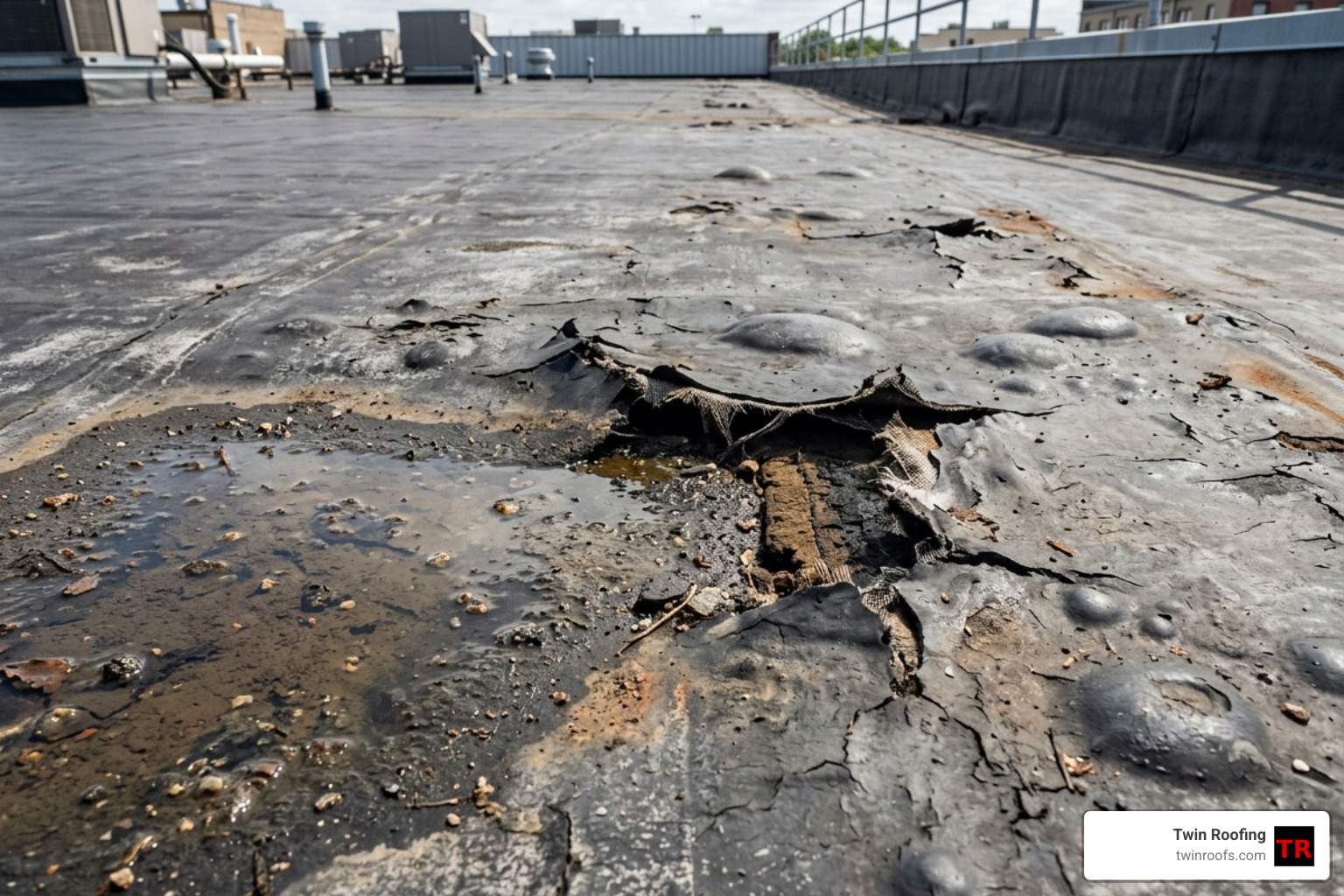
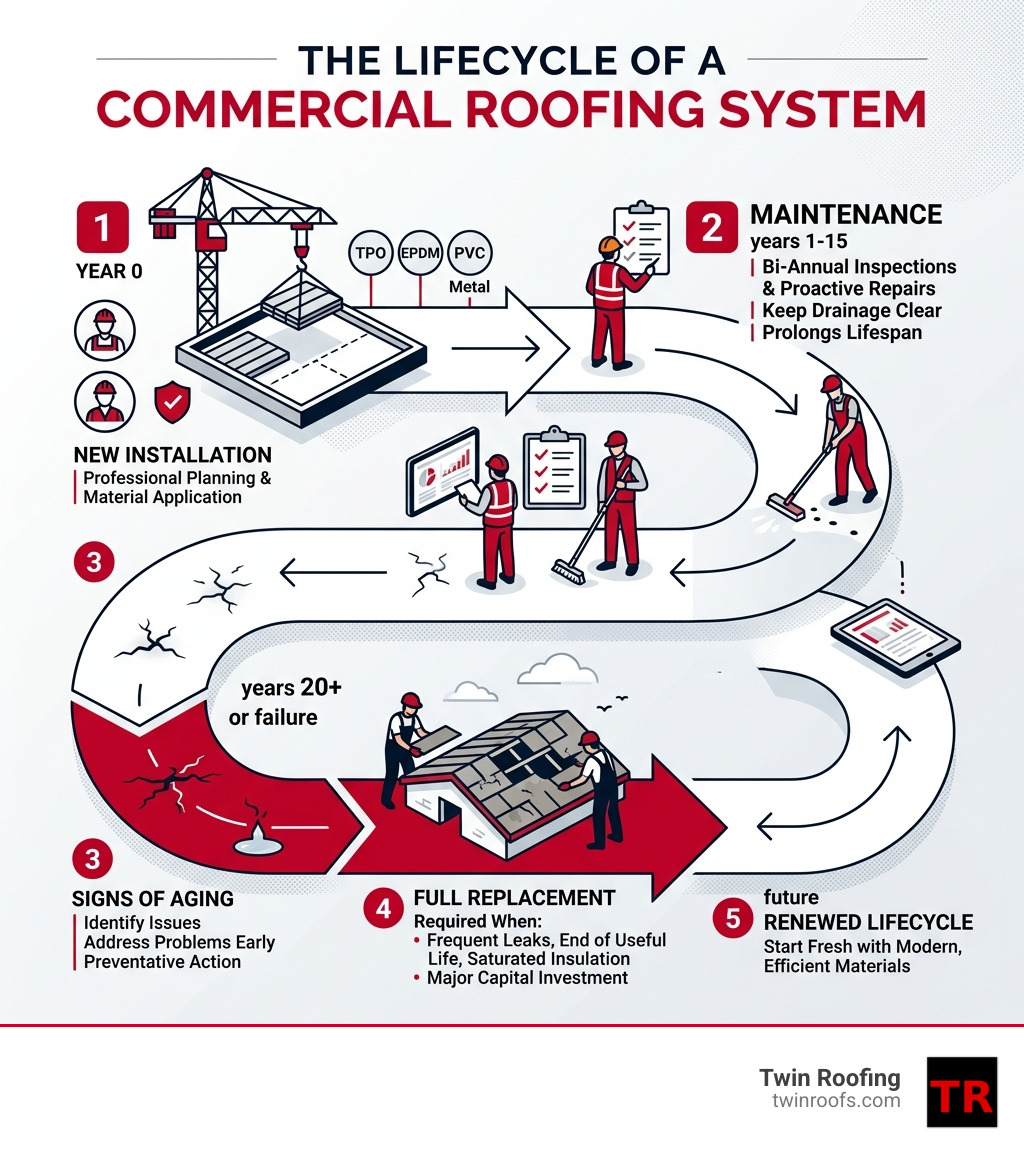
Deciding between a patch job and a full commercial roofing replacement is a high-stakes choice. In the Northeast, where we face everything from April’s heavy rains to January’s ice dams, timing is everything. While 85% of commercial roof replacements could technically be prevented with early intervention, there comes a point where the structure simply says “no more.”
The most obvious sign is age. Most commercial flat roofs have a lifespan of 15 to 30 years. If your roof is celebrating its 20th birthday and you’re seeing frequent leaks, it’s likely time to plan. Beyond age, keep an eye out for these red flags:
- Persistent Leaks: If you are calling us for repairs every time it rains in Andover or Bedford, the cost of patches will soon eclipse the cost of a new roof.
- Saturated Insulation: This is a silent killer. When water gets trapped under the membrane, your insulation becomes a giant sponge. This ruins your R-value, sends energy costs soaring, and can cause the roof deck to rot or sag.
- Membrane Damage: Look for widespread blistering, cracking, or failing seams. On commercial rubber roofing (EPDM), seams are often the first place to fail.
- Rising Energy Bills: If your HVAC system is working overtime, it might be because your roof’s thermal barrier is compromised.
Understanding the Commercial Roof Replacement Process: Step-by-Step Guide is essential for any property manager looking to avoid a catastrophe.
Comparing Commercial Roofing Materials and Systems
Selecting the right material is like choosing the right winter coat for a Boston winter—you want something that looks good but, more importantly, keeps the elements out. Each system has its own personality, strengths, and price point.
| Material | Lifespan | Best For | Key Advantage |
|---|---|---|---|
| TPO | 20–30 Years | Retail & Warehouses | Highly reflective, energy-efficient |
| EPDM | 25–30 Years | Industrial Buildings | Flexible in cold climates |
| PVC | 20–30 Years | Restaurants/Labs | Chemical and grease resistance |
| Metal | 30–40+ Years | Architectural/Sloped | Ultimate durability and aesthetics |
| Mod-Bit | 15–25 Years | High-traffic roofs | Multi-ply toughness |
When choosing the right commercial flat roof, we consider the building’s use. A restaurant in Newton needs grease resistance (PVC), while a warehouse in Burlington might prioritize the cost-effectiveness of TPO. For buildings with sloped sections, commercial metal roofs offer a lifespan that often exceeds 40 years.
Single-Ply Membranes in Commercial Roofing Replacement
Single-ply membranes are the heavy hitters of the commercial world. TPO (Thermoplastic Polyolefin) currently holds about 40% of the market share because it’s a “cool roof” that reflects UV rays, keeping buildings in cities like Waltham or Brookline much cooler in the summer.
EPDM (Ethylene Propylene Diene Terpolymer) holds about 22% of the market. It’s essentially a giant rubber sheet. Its biggest pro? It stays flexible even when the temperature drops to zero, which is a frequent occurrence in Southern New Hampshire.
PVC is the premium choice for specific environments. If you’re running a commercial kitchen where grease is vented onto the roof, PVC won’t break down like other materials will. All three of these systems often feature hot-air welded seams, creating a monolithic, watertight barrier that is much stronger than taped seams.
Metal and Asphalt Options for Commercial Roofing Replacement
Not every commercial building is a flat-roofed warehouse. Many offices and retail centers in Acton or Concord feature sloped roofs. For these, commercial shingle roofs using high-grade architectural asphalt shingles provide a classic look with modern durability.
Modified Bitumen (Mod-Bit) is an evolution of the old “hot tar” roofs. It uses multiple layers of asphalt-based sheets, often reinforced with fiberglass or polyester. It’s incredibly tough and can handle foot traffic much better than a thin single-ply membrane.
The Step-by-Step Commercial Roof Replacement Process
A commercial roofing replacement isn’t just a weekend project; it’s a phased engineering feat. Here is how we handle it from start to finish:
- Inspection and Planning: We start with a walk-through. We often use infrared moisture scanning to find hidden wet spots in the insulation.
- Core Cuts: We take physical samples of the roof layers. This tells us exactly what we’re dealing with—how many layers are already there and the condition of the deck.
- The Tear-Off: This is the messy part. We remove the old membrane and insulation down to the structural deck.
- Deck Repair: Once the deck is exposed, we inspect it for rot or rust. If the “foundation” of your roof is weak, the new roof won’t last.
- Insulation Installation: Modern codes usually require higher R-values. We install rigid foam insulation, often using a “tapered” design to ensure water flows toward the drains instead of ponding.
- Membrane Application: The new TPO, EPDM, or PVC is rolled out and secured—either mechanically fastened with screws or fully adhered with glue.
- Final Walkthrough: We check every seam, flashing, and drain. We also ensure a manufacturer’s representative inspects the work if a NDL (No Dollar Limit) warranty is involved.
For a more granular look, check out this full commercial roof replacement process breakdown.
Budgeting and Cost Factors for 2026 Projects
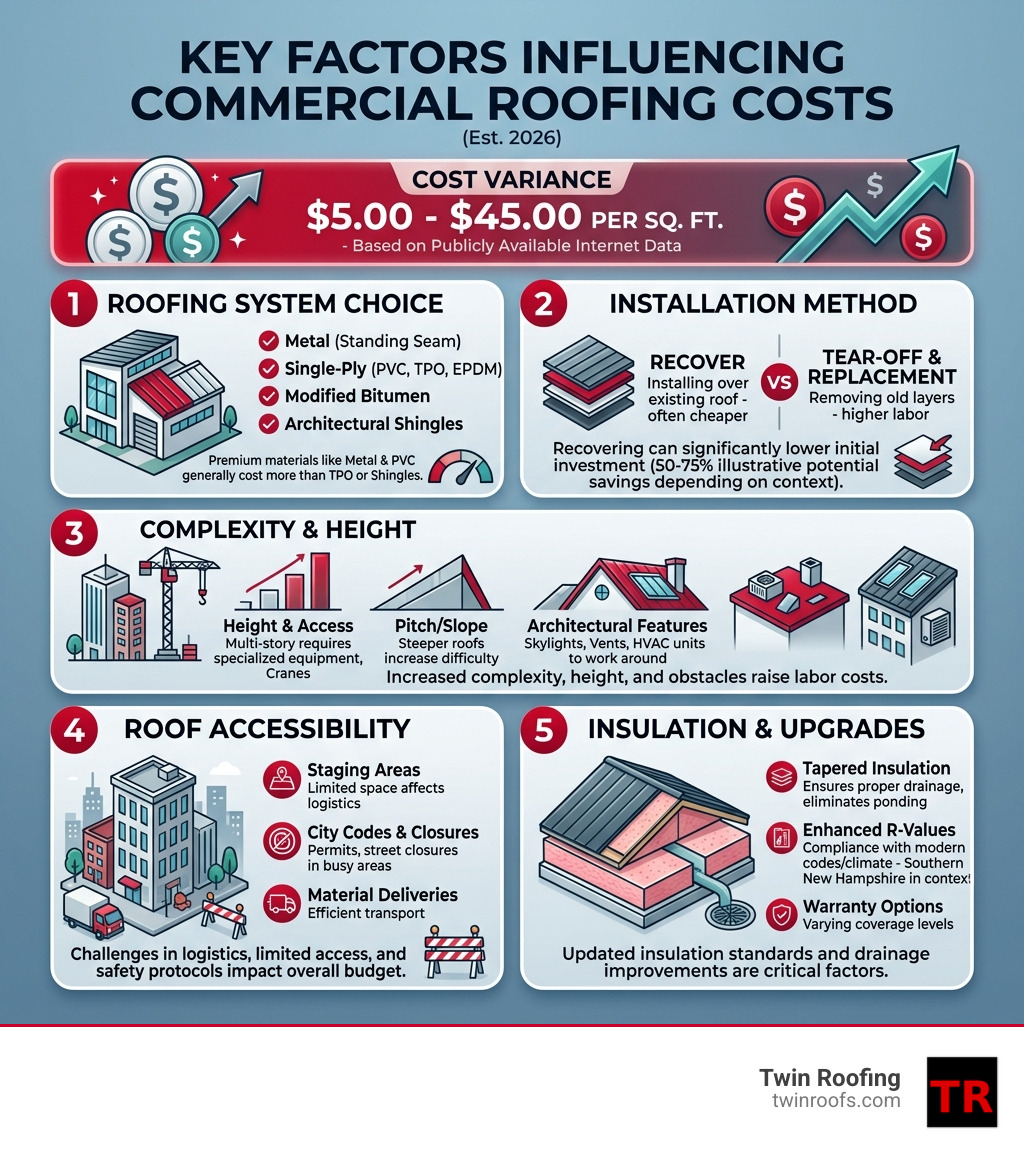
Let’s talk numbers. Based on publicly available internet data, the average cost for commercial roofing replacement in 2026 ranges from $5.00 to $45.00 per square foot. Why such a huge gap? Because every building is unique.
- Material Choice: TPO is generally more affordable than PVC or high-end standing seam metal.
- Tear-off vs. Recover: If your insulation is dry and local codes allow it, you might be able to “recover” (install a new layer over the old one). This can save 50–75% compared to a full tear-off.
- Building Height and Access: A one-story warehouse in Billerica is much cheaper to roof than a multi-story office building in Brookline that requires cranes and street closures.
- Penetrations: The more vents, skylights, and HVAC units on your roof, the more labor is required for flashing.
While the initial check is large, remember the ROI. A reflective “cool roof” can significantly lower your monthly cooling costs, helping you protect your business assets over the long haul.
Frequently Asked Questions about Commercial Roofs
How can I minimize business disruption during replacement?
We get it—you have a business to run. We minimize noise and mess by creating designated staging areas for materials and debris. We often schedule the loudest work (like the tear-off) during off-peak hours or weekends. Clear communication with tenants is key; we provide schedules so everyone knows when the cranes are coming. If you’re looking for commercial roofing service near me, always ask how the contractor handles noise and access.
What is the difference between a full tear-off and a recover?
A full tear-off removes everything down to the deck. A “recover” (or re-roof) involves leaving the existing roof in place and covering it with a new membrane. Building codes in MA and NH generally only allow two layers of roofing. If you already have two layers, or if your insulation is wet, a full tear-off is your only legal and professional option.
Why are manufacturer certifications important for warranties?
Think of it like a car warranty—if you get your engine fixed by a non-certified mechanic, the manufacturer might not honor the warranty. We are GAF and CertainTeed certified, which means we can offer enhanced warranties that cover both materials and our workmanship. This gives you peace of mind that if something fails, the manufacturer stands behind the repair.
Conclusion
A commercial roofing replacement is a massive undertaking, but it’s also an opportunity to upgrade your building’s efficiency and value. At Twin Roofing, we specialize in asphalt shingle and metal installations that stand up to the unique rigors of the Northeast climate. From the historic streets of Salem to the industrial parks of Nashua, we bring superior performance and quality materials to every job.
Whether you are in Acton, Newton, or Manchester, your roof is your first line of defense. Don’t wait for a ceiling collapse to start the conversation. We are here to help you navigate the complexities of commercial roofing with transparency and expertise.
The company services Berkshire County in Eastern Massachusetts and Southern New Hampshire.
Follow us on Facebook — https://www.facebook.com/twinmetalsroofing Follow us on Instagram – https://www.instagram.com/twinmetals/