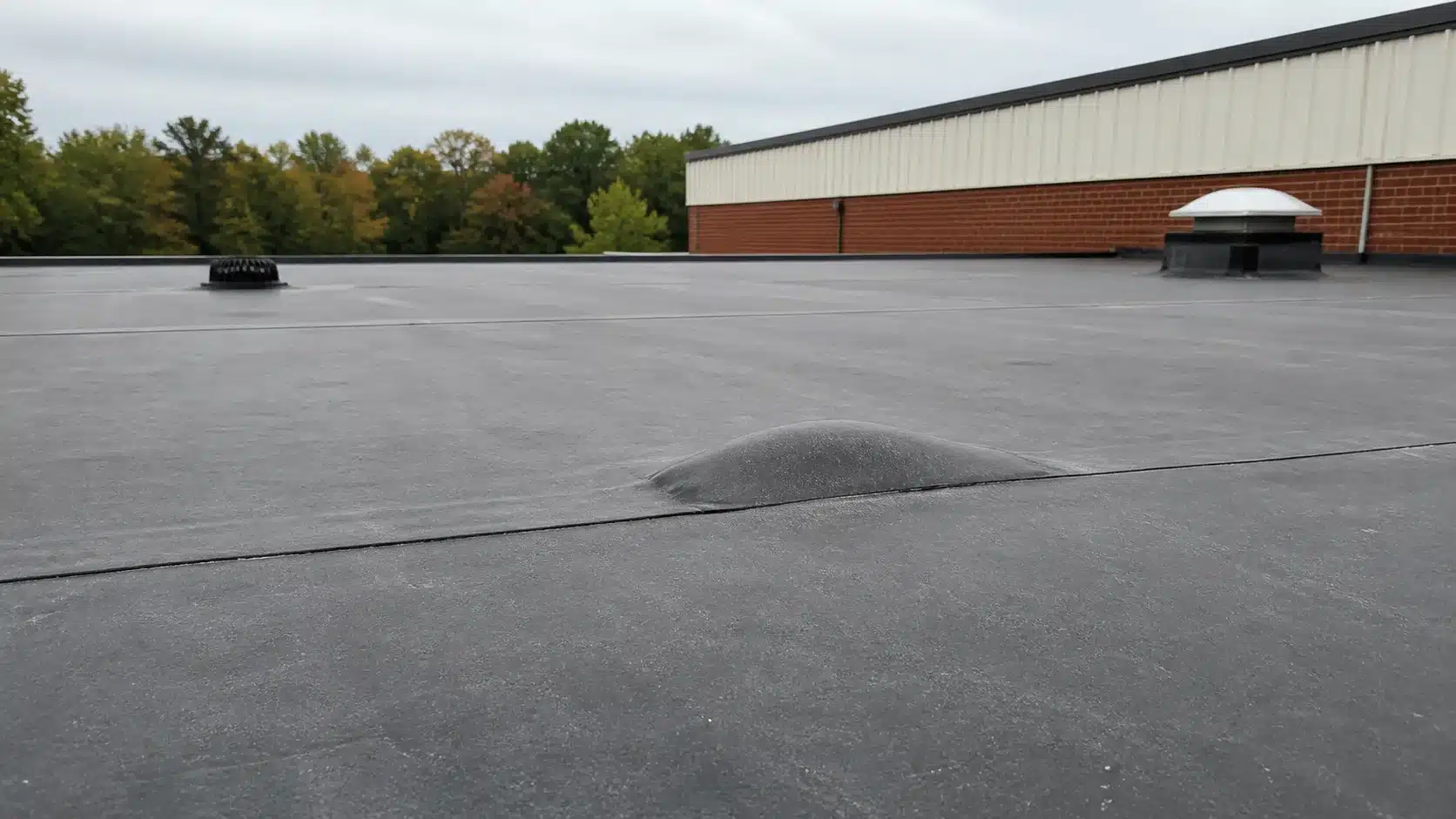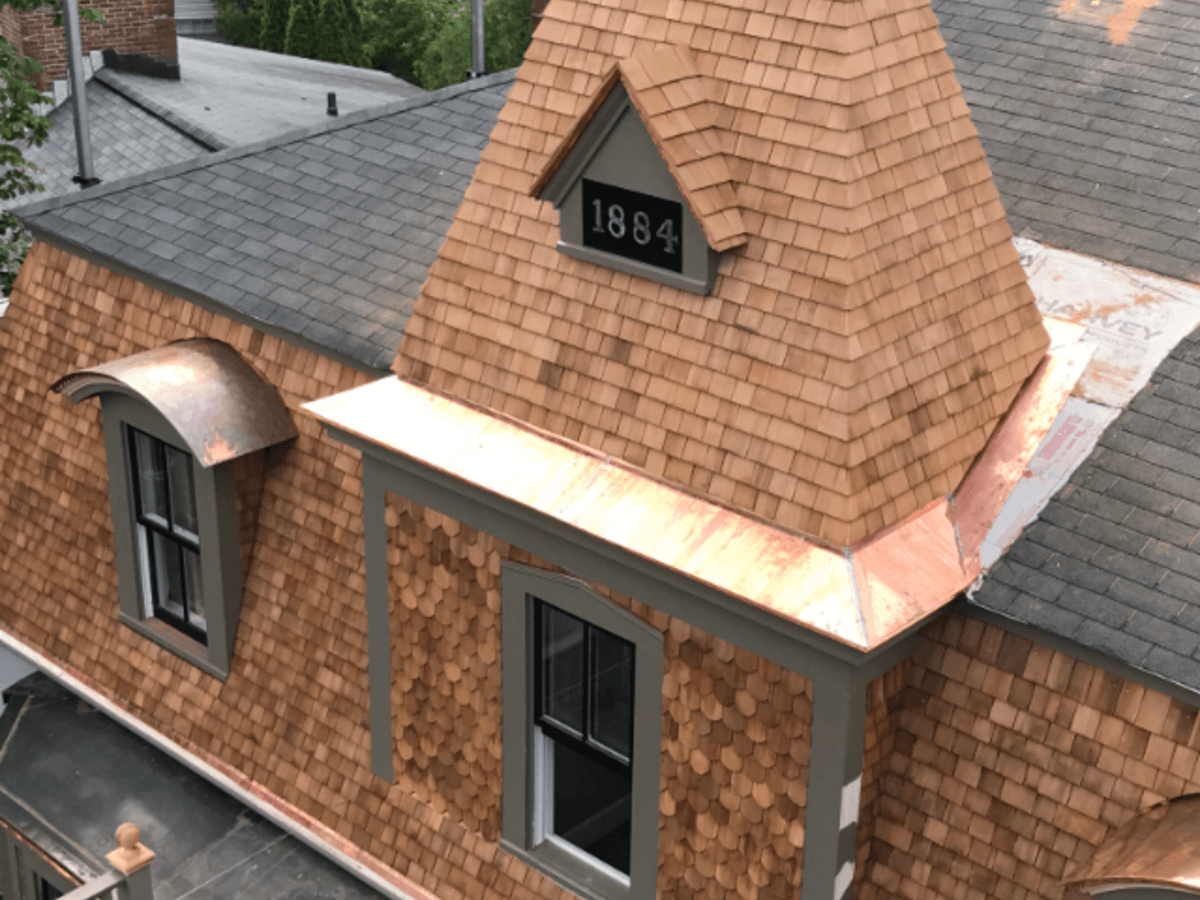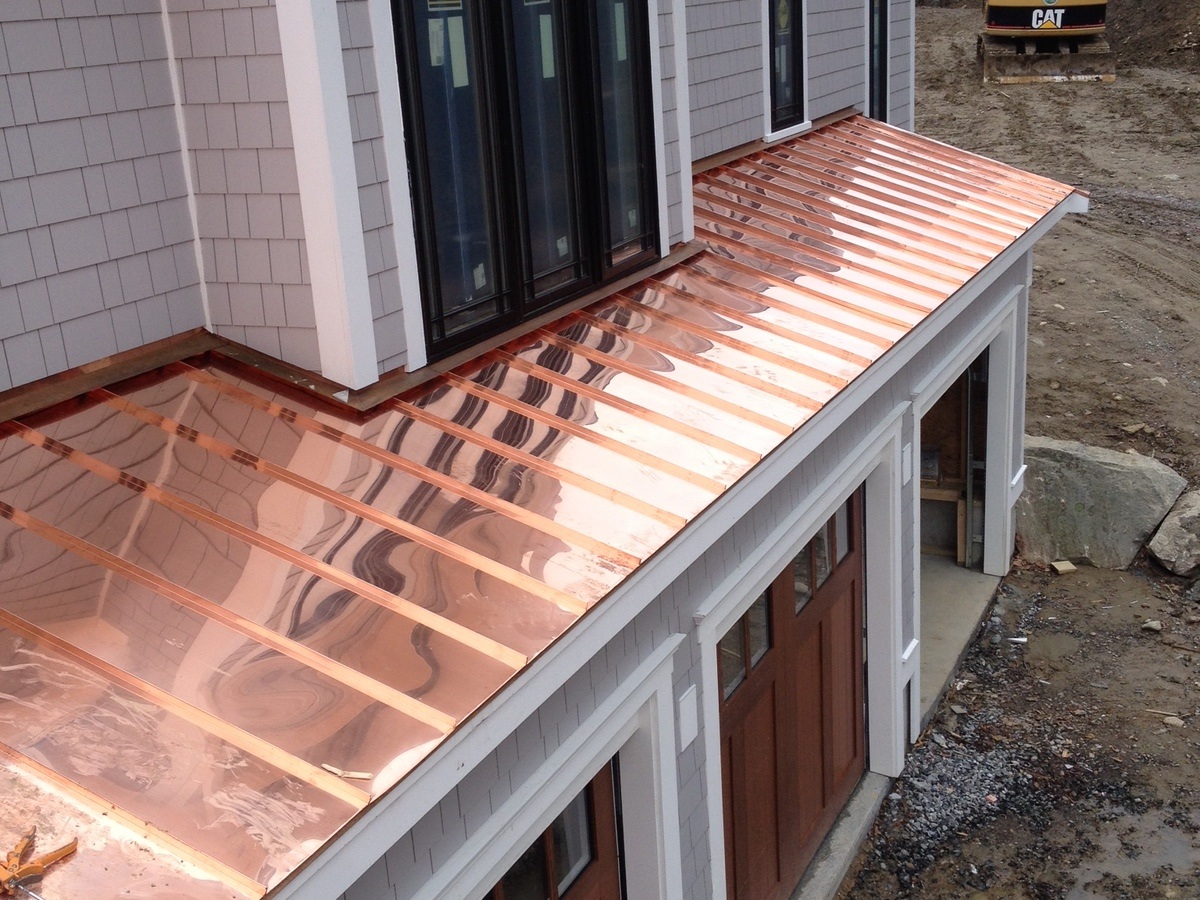
Flat roof blistering is a raised area in or below a roof membrane. A bubble can come from trapped air or moisture, an attachment problem, or movement within the roof assembly—but the shape alone does not identify the cause. Record where it is, how large it is, and whether it changes before a qualified roofer decides what it needs.
Start with the pattern, not a diagnosis
A wrinkle, bridged membrane, displaced insulation, deck movement, or an older repair can resemble a blister from a distance. Do not cut the surface to find out. An opening can turn a contained condition into a water-entry point and may affect warranty or repair options.
| What you can observe safely | Why it matters | Appropriate next step |
|---|---|---|
| One stable raised area, no interior moisture | It may be localized, but appearance alone does not show what is below it | Photograph from the same safe position, mark the date, and arrange a roof-system review |
| Several blisters or a pattern across a broad area | A widespread pattern can point to moisture, substrate, attachment, or installation conditions | Request a prompt assessment that considers the complete assembly, not only the surface |
| A blister beside a seam, penetration, drain, edge, or old repair | The location can affect water-entry and repair risk | Record the exact roof feature and recent weather; do not press, puncture, or probe it |
| Rapid change, a split surface, active water, or a sagging interior | The condition may no longer be contained | Protect people and operations below it and request urgent professional evaluation |
Why flat roof blisters can form
Low-slope roofs are assemblies: deck, air or vapor controls where used, insulation, cover board where used, attachment or adhesive, membrane, seams, flashings, and drainage details. Air or moisture trapped between layers can expand as the roof warms. Wet materials, an existing leak, unsuitable attachment, or a substrate condition can also contribute. The cause and repair path depend on the installed system.
Johns Manville’s re-roofing guide distinguishes occasional membrane blistering from severe blistering across a roof area and says the exact cause should be determined so it can be addressed. That is an important boundary: the number, distribution, roof history, and material layers matter more than the word “bubble.”
EPDM, TPO, PVC, modified-bitumen, and built-up roofs do not use one identical repair detail. If you do not know the membrane or attachment method, the site’s comparison of EPDM, TPO, and PVC roof assemblies explains why the visible surface is only one part of the decision.
Keep observations safe and repeatable
Do not walk an unfamiliar, wet, icy, or visibly changed roof. Facility staff and homeowners can gather useful evidence from the ground, an adjacent building, a fixed camera position, or an accessible interior area without stepping onto the membrane.
- Record the date, outdoor temperature range, sun exposure, recent rain, snow, or snowmelt.
- Note whether the raised area changes between a cool morning and a warmer afternoon.
- Identify the nearest visible seam, drain, edge, curb, penetration, equipment pad, or prior repair.
- Photograph ceiling stains, damp insulation, odors, or finish changes directly below the area.
- Record recent HVAC, solar, electrical, snow, drainage, or other rooftop work.
- Preserve warranty, installation, repair, and roof-plan documents for the inspector.
Use urgency signals without guessing at the cause
A stable isolated blister with no interior symptom still deserves documentation, but it is different from active leakage or structural movement. Escalate quickly when water reaches electrical equipment, a ceiling bulges, finishes begin falling, the roof line changes, or a raised area splits or expands rapidly. Keep people away from the affected interior area until the immediate hazard is assessed.
In Massachusetts, a useful record spans more than one condition. Cold nights, sunny daytime warming, heavy rain, snow cover, snowmelt, and freeze-thaw changes can make a symptom appear or change. Those observations do not prove the cause; they give the roofer a timeline to compare with the assembly and drainage path.
Ask for an assembly-level assessment
A complete assessment should identify the roof system and connect the surface condition to the layers below it. The report should distinguish what was directly observed from what remains unknown.
- Map the condition: location, count, dimensions, surface state, nearby details, and change over time.
- Identify the system: membrane type, attachment method, insulation and cover-board information, known repairs, and warranty status.
- Look for related evidence: interior moisture, drainage patterns, open seams or flashings, displaced components, and recent rooftop work.
- Define the next investigation: whether non-destructive moisture review, a controlled test opening, or another method is justified and who is authorized to perform it.
- Set the repair and follow-up: scope, affected layers, limitations, warranty coordination, and the condition that will confirm closure.
Match the response to the confirmed system
Cutting and patching every raised area is not a diagnosis. Monitoring every raised area indefinitely is not a plan either. The right response follows the confirmed cause, extent, membrane system, underlying moisture, and warranty requirements.
Twin Roofing provides commercial rubber-roofing services from Billerica, Massachusetts. Share the photo timeline, roof documents, interior symptoms, and recent rooftop work when requesting an assessment; that evidence makes flat roof blistering easier to evaluate without guessing from the surface.