Why Metal Roof Flashing Installation Is the Most Critical Part of Any Metal Roof
Metal roof flashing installation is the process of fitting thin metal strips at every vulnerable joint, edge, and penetration on a roof to stop water from getting in. Done right, it keeps a metal roof watertight for decades. Done wrong, it becomes the number one reason roofs fail — long before the panels ever do.
Here is a quick overview of what proper metal roof flashing installation involves:
- Choose the right material — aluminum, galvanized steel, or copper matched to your roof panels
- Prepare the surface — clean deck, extended underlayment, ice and water shield at edges
- Install flashing at every transition — valleys, walls, chimneys, rakes, and eaves
- Secure mechanically — nails, screws, or seam clamps with neoprene washers
- Seal all joints — butyl tape or compatible sealant as a secondary line of defense
- Test and inspect — run water along seams and check twice a year
Metal panels themselves rarely fail. It is the flashing — quietly managing water at valleys, chimneys, and edges — that determines whether a roof performs for 40 years or becomes a recurring repair bill.
I’m Tom Gordon, owner of Twin Roofing, a division of Twin Metals, Inc., and I’ve spent nearly two decades overseeing metal roof flashing installation across Massachusetts and New Hampshire. In this guide, I’ll walk you through everything you need to know to get it right the first time.
Understanding Materials and Types for Metal Roof Flashing Installation
When we talk about a Durable Metal Roof, we aren’t just talking about the strength of the panels. We are talking about the chemistry and physics of the flashing. In April 2026, the industry standard has moved toward higher-grade materials that can handle the intense New England freeze-thaw cycles found in areas like Andover, MA and Auburn, NH.
| Material | Lifespan | Best Use Case |
|---|---|---|
| Aluminum | 20–40 Years | Lightweight, rust-resistant, great for coastal MA |
| Galvanized Steel | 15–30 Years | Cost-effective, strong, requires high-quality coating |
| Copper | 50+ Years | Premium durability, beautiful patina, highly flexible |
Choosing the right material for your Residential Metal Roof is about more than just looks; it’s about avoiding galvanic corrosion. This happens when two different metals (like an aluminum panel and a copper flashing) touch each other in the presence of moisture. The resulting chemical reaction eats through the metal, causing leaks. We always ensure material compatibility by matching the flashing metal to the panel metal or using non-conductive barriers like neoprene tape.
Furthermore, metal moves. Thermal expansion and contraction can cause a metal roof to “grow” or “shrink” by fractions of an inch every day. If your flashing is pinned too tightly without room to breathe, it will buckle or pull its fasteners out. We use EPDM pipe boots and high-grade silicone sealants because they remain flexible even when the temperature drops to zero in a New Hampshire winter.
Essential Components for a Watertight System
A complete metal roof flashing installation requires several specialized pieces, many of which we produce in our own Sheet Metal Fabrication Shop.
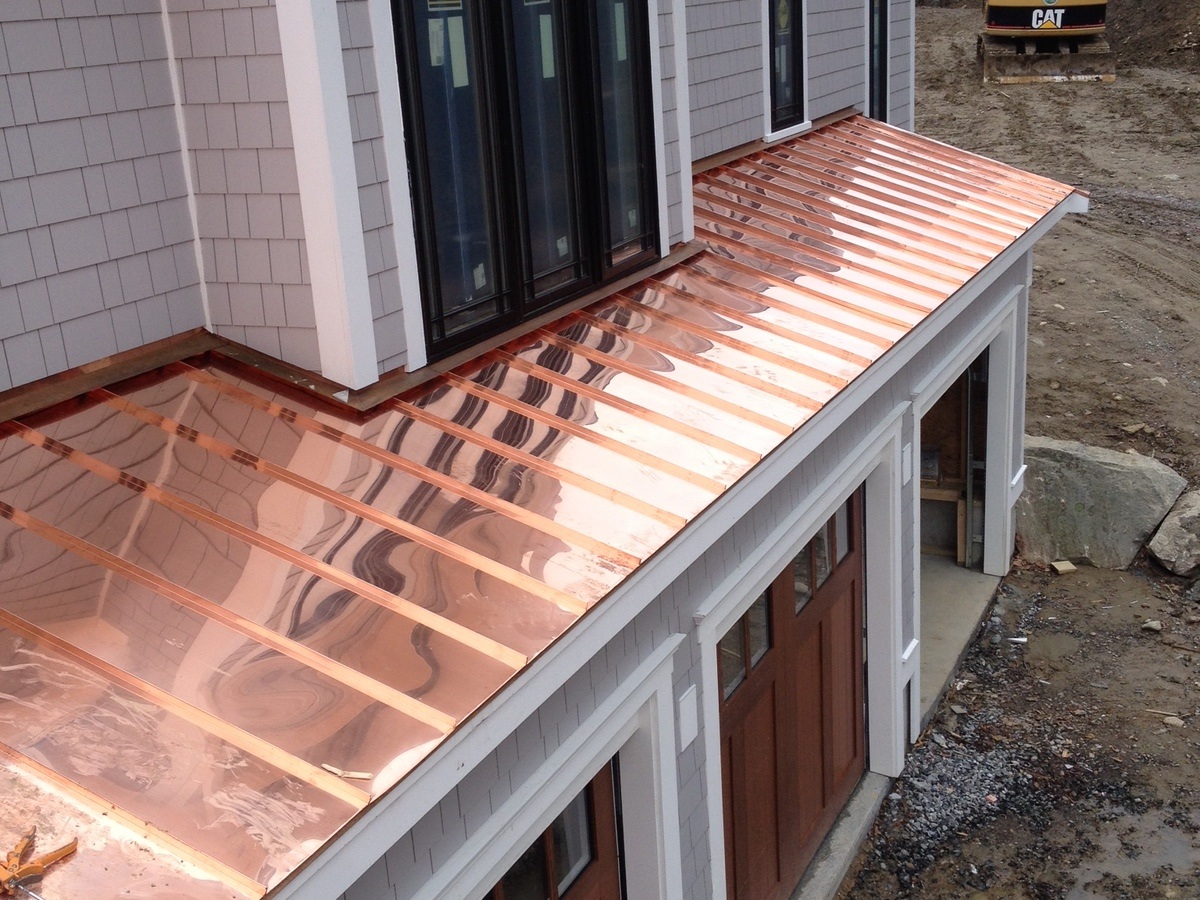
- Drip Edge: Installed along the eaves and rakes to direct water into the gutters and away from the fascia.
- Valley Flashing: A W-shaped or V-shaped channel that handles the massive volume of water where two roof planes meet.
- Step Flashing: Individual “steps” used where a roof meets a side wall.
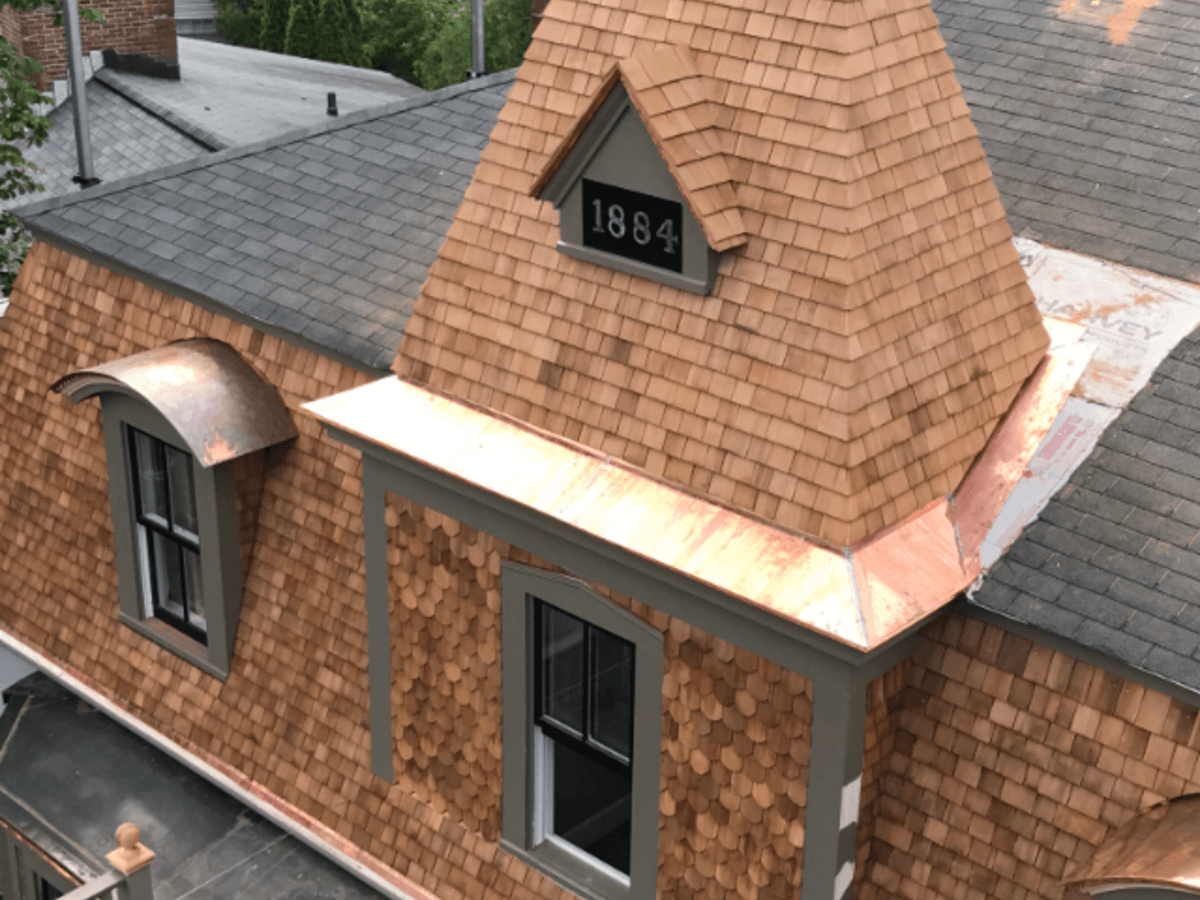
- Counter-Flashing: A second layer of metal that laps over the base flashing, often tucked into a groove (reglet) in masonry chimneys.
- Apron Flashing: Used at the front of a chimney or where a roof meets a headwall.
Choosing the Right Gauge and Finish
The thickness, or “gauge,” of your flashing matters. For most residential projects, 24-gauge or 26-gauge steel is the gold standard. When you Steel Yourself for the Best Types of Metal Residential Roofing, look for finishes like Kynar 500. This resin-based coating resists fading and chalking, which is essential for homes in salt-spray zones like Beverly or Peabody, MA. Aesthetic matching ensures the flashing blends seamlessly with your panels for a clean, professional look.
Step-by-Step Metal Roof Flashing Installation Guide
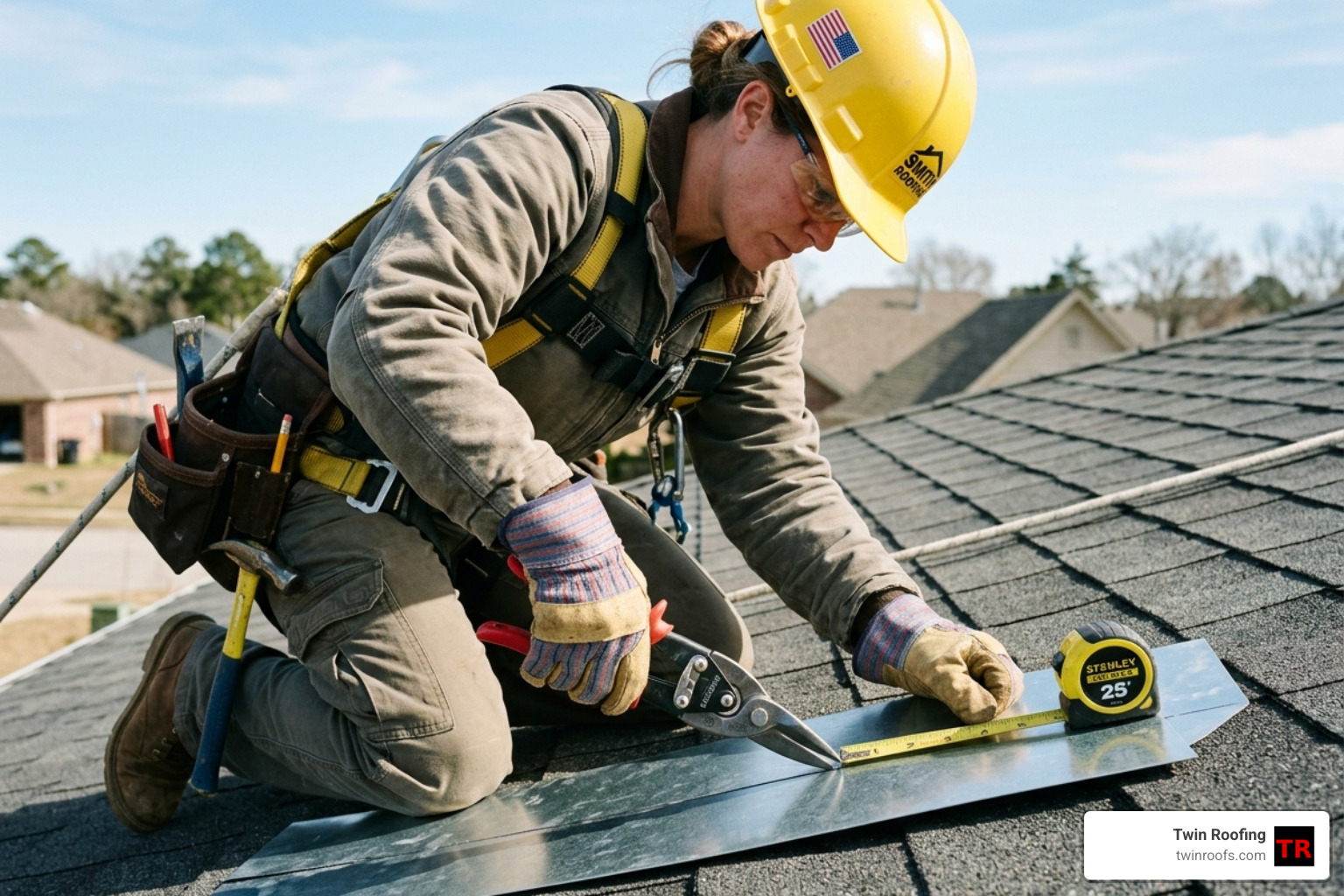
Before the first piece of metal is ever laid, preparation is key. Following Metal Roof Edge Flashing Installation Best Practices ensures that the foundation of your roof is sound.
- Surface Preparation: We start by clearing all debris, old nails, and dust from the roof deck. The substrate must be dry and flat.
- Chalk Line Snapping: Accuracy is everything. We snap chalk lines to ensure the drip edge and rakes are perfectly straight.
- Fastener Spacing: Our Metal Roof Installers typically space fasteners every 10 to 12 inches to provide maximum wind resistance without over-constraining the metal.
Preparing the Roof Deck for Metal Roof Flashing Installation
The metal is your primary defense, but the underlayment is your safety net. Why Your Next Roof Should Be Metal often comes down to the superior “system” approach. We extend the underlayment 4 to 6 inches up any vertical walls. In our local climate, we always install a self-adhering ice and water shield at the eaves and valleys. This moisture barrier protects against ice dams, which are a common headache in towns like Billerica and Lowell.
Securing and Sealing the Perimeter
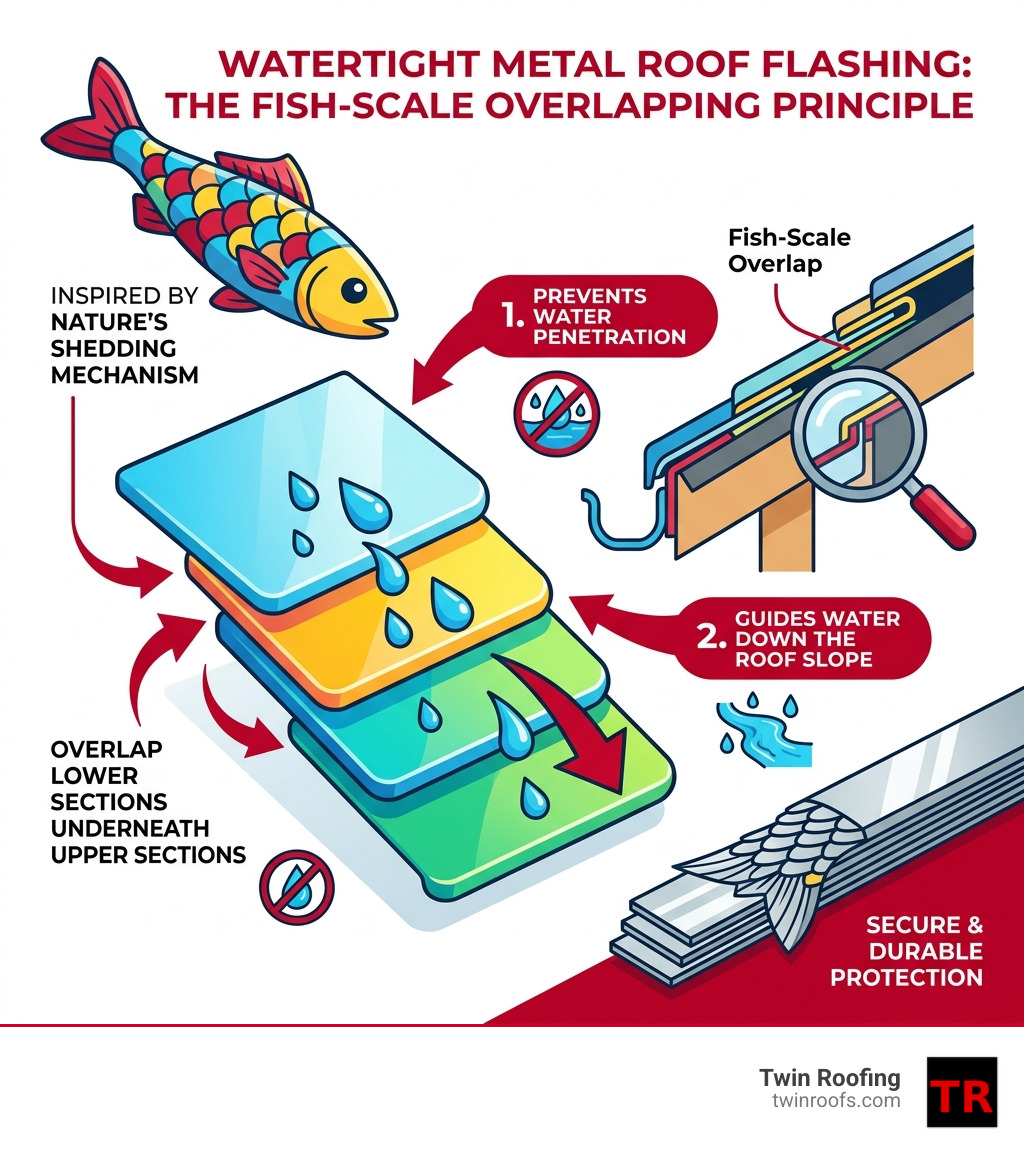
When installing the perimeter metal, we follow the “fish-scale” principle: every piece must overlap the one below it by at least two inches. For Commercial Metal Roofs, we often use butyl tape between these overlaps to create a gasket-like seal.
We use fasteners with neoprene washers to prevent water from seeping through the screw holes. Mechanical integration—meaning the pieces fit together like a puzzle—is always better than relying on a bead of caulk. While we use pop rivets for some joints, the primary goal is a system that sheds water naturally.
Specialized Techniques for Valleys, Chimneys, and Standing Seam

Chimneys and valleys are the “high-traffic” areas for water. If a leak is going to happen, it’s usually here. When considering Is a Flat Metal Roof Right for Your Home Unpacking the Pros and Cons, transitions are even more critical on low-slope surfaces.
We use water crickets—small peaked structures behind the chimney—to divert water around the wide base. Kickout flashing is another essential tool; it directs water away from the wall and straight into the gutter, preventing the “wall rot” often seen in older homes in Arlington or Brookline.
Non-Penetrating Metal Roof Flashing Installation
For homeowners who choose a standing seam system, we can perform a metal roof flashing installation without ever putting a hole through the panels. As a Standing Seam Metal Roof Installer in Belmont Massachusetts, we use:
- Seam Clamps: These grip the vertical ribs of the panels to hold flashings in place.
- Z-Closures: These metal strips fit between the ribs to seal the top or bottom of a run.
- Sliding Cleats: These allow the roof to expand and contract freely, preserving your warranty and preventing the “oil canning” (wavy appearance) that happens when panels are pinned down too tight.
Managing Penetrations and Pipe Boots
Every pipe that pokes through your roof is a potential leak. We use specialized products like Master Flash boots, which are engineered for the unique profiles of metal roofs. Before sliding the boot on, we chamfer (bevel) the edge of the pipe to ensure a smooth, tight fit.
If you are dealing with Roof Flashing Repair in Andover, MA, you might notice that older EPDM boots have cracked. In these cases, we often install a rain collar over the existing boot for a secondary seal, or we field-form a custom metal pan for larger mechanical stacks.
Avoiding Common Pitfalls and Ensuring Longevity
The most common mistake we see is an over-reliance on sealant. Sealant is a secondary helper, not a primary structural component. Over time, UV rays from the sun will bake the sealant until it cracks and fails. If the flashing isn’t mechanically sound, that sealant fatigue will lead to a leak within 5 to 10 years.
Other pitfalls include:
- Mixing Metals: Using galvanized nails on copper flashing (leading to rapid corrosion).
- Insufficient Overlap: Water can “wick” upward through capillary action if overlaps are less than two inches.
- Over-tightened Fasteners: This prevents thermal movement and causes the metal to buckle.
Working with experienced Metal Roofing Companies Near Me ensures that your project meets local Massachusetts and New Hampshire building codes, which are specifically designed to handle our heavy snow loads.
Maintenance and Post-Installation Testing
Once the metal roof flashing installation is complete, we don’t just walk away. We perform a hose test, spraying water at high pressure along the seams and transitions to confirm watertight performance.
For long-term health, we recommend:
- Bi-annual Inspections: Check your flashing in the spring and fall.
- Clearing Debris: Leaves trapped in valleys or behind chimneys can hold moisture and lead to Roof Flashing Repair in Beverly, MA.
- Fastener Tightening: Occasionally, thermal movement can loosen a screw; a quick turn can prevent a future leak.
Estimating Costs for Flashing Projects
Based on publicly available internet data, the average cost for professional flashing installation in 2026 ranges from $15 to $25 per linear foot for standard materials. However, premium custom copper work or complex chimney crickets can range from $30 to over $90 per linear foot depending on the complexity of the roof and the height of the home.
Frequently Asked Questions about Metal Flashing
Can I reuse old flashing when installing a new metal roof?
We generally advise against it. Removing old flashing usually bends it out of shape, and existing nail holes are difficult to seal perfectly. A new metal roof is a 40-year investment; it doesn’t make sense to risk it on 20-year-old flashing.
How do I prevent galvanic corrosion between different metals?
The best way is to use the same metal for both the panels and the flashing. If you must mix them, we use non-conductive barriers like bituminous tape or neoprene gaskets to keep the metals from touching.
When should I repair flashing versus replacing the entire section?
If the metal is sound but a fastener has come loose or a sealant has cracked, a repair is fine. However, if you see rust, “pitting” from corrosion, or if the flashing was improperly designed from the start, a full replacement is the only way to guarantee a dry home.
Conclusion
Twin Roofing, a division of Twin Metals Inc., specializes in high-performance metal and asphalt roofing solutions. While metal systems offer incredible longevity, the quality of the installation—specifically the flashing—determines the ultimate success of the project. Twin Roofing also installs asphalt roofs in MA and NH, ensuring every transition and penetration is handled with expert precision. For homeowners seeking a permanent solution to New England weather, professional flashing is the most critical investment you can make.
More info about residential metal roofing
Twin Roofing services Berkshire County in Eastern Massachusetts and Southern New Hampshire. We proudly serve homeowners in Acton, Bedford, Concord, Lexington, Waltham, and throughout the North Shore and Southern NH.
Follow us on Facebook — https://www.facebook.com/twinmetalsroofing Follow us on Instagram – https://www.instagram.com/twinmetals/